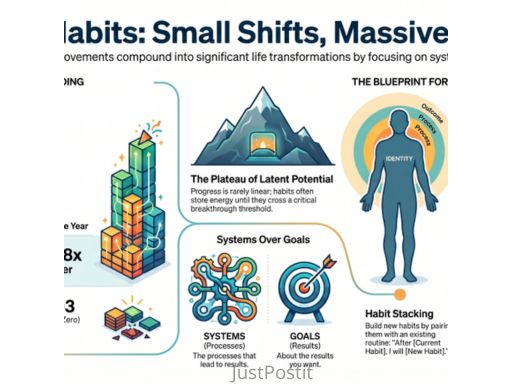
DEBUNKING ATOMIC HABITS
1. The Myth of the "Overnight Success" and Linear Progress
The Concept: The book’s primary claim is that getting 1% better every day compounds into remarkable results, making you 37 times better by the end of the year. The Debunk: The math looks great on paper, but Clear admits that human progress is incredibly frustrating and inherently non-linear. The book introduces the "Plateau of Latent Potential," which proves that small changes often appear to make zero difference until you cross a critical threshold. In the early and middle stages of any endeavor, you will experience a "Valley of Disappointment" where it feels like you are going nowhere. Therefore, the promise of small habits is fundamentally a game of delayed gratification—meaning you will likely feel discouraged and see no tangible results for months or even years.
2. The Fallacy of Goal-Setting
The Concept: Traditional advice says you need specific, actionable goals to succeed. Clear debunks this by arguing you should forget goals and focus on "systems". The Debunk: Clear attacks the idea of goals by stating that "winners and losers have the same goals," meaning the goal itself cannot be the differentiator of success. He also argues that goals restrict your happiness, as they force you to put off satisfaction until a milestone is reached, and they create a "yo-yo" effect where people revert to bad habits after crossing the finish line. However, even Clear concedes that systems alone are aimless; goals are actually necessary for "setting a direction". You cannot completely abandon goals, or your system will have no target.
3. The Danger of "Identity Change"
The Concept: The most effective way to change a habit is to focus on who you wish to become (identity-based habits) rather than what you want to achieve (outcome-based habits). The Debunk: While changing your identity is presented as the ultimate solution, Clear admits it is a massive "double-edged sword". Once you tie a habit deeply to your identity, it creates a "cognitive slumber" where you blindly follow norms and resist positive change because it contradicts "who you are". Furthermore, holding onto an identity too tightly makes you "brittle". If your identity is tied to being an athlete, a CEO, or a vegan, and a life event (like an injury or health issue) forces that to change, you will suffer a massive identity crisis.
4. Willpower and Motivation are Largely Illusions
The Concept: Society tells us that bad habits are a "moral weakness" and that success requires immense willpower and discipline. The Debunk: Clear debunks the concept of willpower entirely, noting that "disciplined" people don't actually possess heroic self-control; they simply spend less time in tempting situations. Self-control is exposed as a "short-term strategy, not a long-term one". Your habits are actually dictated by the "invisible hand" of your environment. This means if you are trapped in a toxic or high-friction environment, no amount of motivation will save you. You are at the mercy of your surroundings unless you have the resources to redesign them.
5. The Fatal Flaw of Habits: Boredom and Complacency
The Concept: If you make habits obvious, attractive, easy, and satisfying (The Four Laws of Behavior Change), they will become automatic. The Debunk: The ultimate goal of a habit is "automaticity", but Clear reveals that this is actually the downfall of mastery. Once a habit becomes automatic, you stop paying attention, you let mistakes slide, and your performance actually declines over time. Habits create complacency. Furthermore, the book admits that "the greatest threat to success is not failure but boredom". Because our brains are wired to seek novelty through "variable rewards," doing the same easy habits every day will eventually stop delighting us, making us want to quit. To be great, you have to "fall in love with boredom," which contradicts the earlier advice to simply make everything "attractive" and "satisfying".
6. The Ultimate Limitation: Genetics Pre-determine Your Ceiling
The Concept: With the right habits, anyone can achieve remarkable results. The Debunk: In the advanced tactics section, Clear drops a harsh truth: genes matter, and they determine your areas of opportunity. Using the example of Olympic swimmer Michael Phelps and runner Hicham El Guerrouj, he notes that physical and mental traits are heavily influenced by genetics. If you do not have the genetic predisposition for a specific field, no amount of atomic habits will make you an elite performer. As Clear writes, "Genes cannot be easily changed, which means they provide a powerful advantage in favorable circumstances and a serious disadvantage in unfavorable circumstances". Your success relies heavily on the "luck" of choosing a game where the odds are biologically stacked in your favor.
Conclusion
As a debunker, my assessment is that while Atomic Habits offers practical behavioral frameworks, it actually dismantles its own optimistic premise. The book ultimately proves that small habits are grueling because progress is delayed, willpower is practically useless, establishing an identity can trap you in a brittle mindset, automated habits lead to skill decline, and ultimately, your absolute potential is rigidly capped by your genetic lottery.
|
Term
|
Definition
|
|---|---|
|
Atomic Habit
|
(1) An extremely small amount of a thing; the single irreducible unit of a larger system. (2) The source of immense energy or power.
|
|
Compound Interest of Self-Improvement
|
The phenomenon where the effects of habits multiply as they are repeated over time, similar to how money grows through interest.
|
|
Diderot Effect
|
The tendency for obtaining a new possession to create a spiral of consumption that leads to additional, often unnecessary, purchases.
|
|
Four Laws of Behavior Change
|
A simple set of rules for building better habits: (1) Make it obvious, (2) Make it attractive, (3) Make it easy, and (4) Make it satisfying.
|
|
Habit
|
A routine or practice performed regularly; an automatic response to a specific situation.
|
|
Habit Stack
|
A series of small habits chained together, where each completed behavior acts as the cue for the next.
|
|
Habits Scorecard
|
A simple exercise used to become more aware of daily behavior by listing and categorizing habits as good, bad, or neutral.
|
|
Implementation Intention
|
A plan made beforehand about when and where to act to ensure a particular habit is performed.
|
|
Plateau of Latent Potential
|
The lag time between doing the work and seeing the results; a period where potential energy is stored before a breakthrough occurs.
|
|
Valley of Disappointment
|
The initial period of a new habit where one expects linear progress but sees little to no result, often leading to a loss of motivation.
|